Floor Map Detail [Wireless Client View]
If you select "Wireless Client View" from the dropdown menu on Floor Map Details, the screen switches to the Wireless Client View screen.
List all connected/disconnected/failed clients for all wireless bands on the floor and see the APs to which the connected wireless clients belong.
If an individual radio band is selected from the radio band drop-down list in the header, the heatmap can also be displayed in a format that matches the "drawing mode" of the floor map control.
For more information on the heatmap view format for each drawing mode, see "Floor map details [radio status view]".
NoteWhen the heat map view is enabled, screen rendering may take some time.
Adjust the update interval of the "Floor MAP (Wireless Client)" in the "User management" screen accordingly.
Wireless Client Association View
This view uses a link line to show an association between a client and an AP.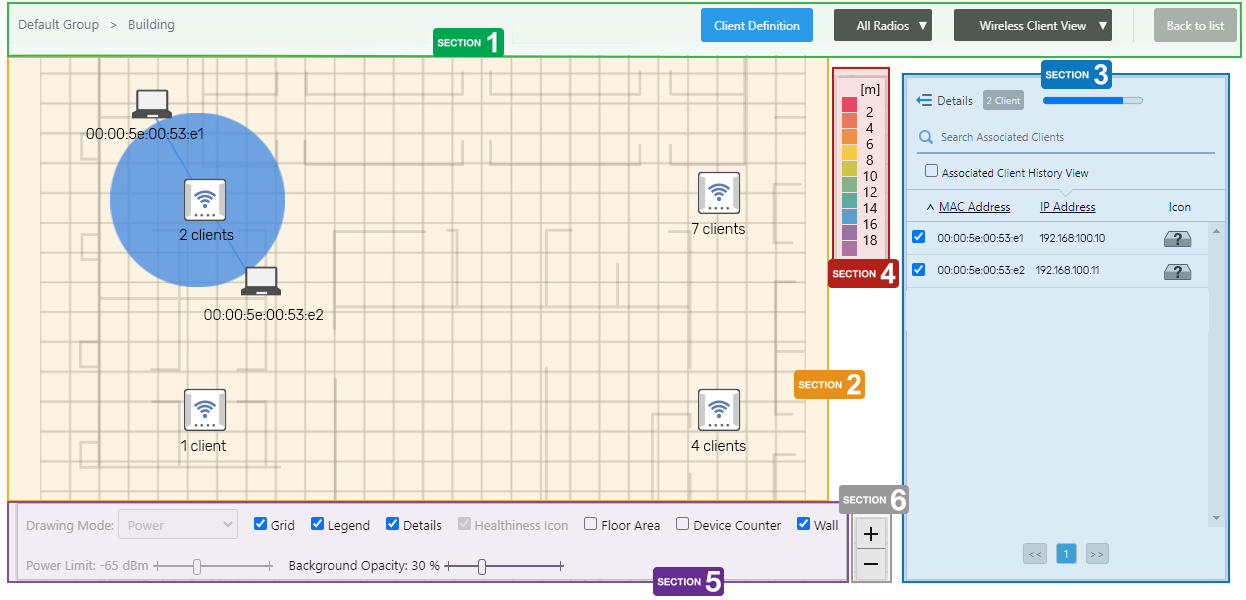
Section 1
| Item Name | Description |
|---|---|
| Management Group / Floor Map Group | The floor map name and the management group of the selected floor map will be displayed. |
| "Client Definition" button | Shows the Client Definition List dialog box. |
| Radio dropdown menu | Select which radio band information to display from Radio 1, Radio 2, Radio 3, or "All Radios". The default is "All Radios". If you select "All Radios", wireless client information for all bands (Radio 1, Radio 2, and Radio 3) will be displayed. |
| View Selection dropdown menu | Lets you change what information is displayed on the Floor Map Details screen.
|
| "Back to list" button | Click to return to the Floor Map List screen. |
Section 2
| Item Name | Description | ||||||||||||||||||||||
|---|---|---|---|---|---|---|---|---|---|---|---|---|---|---|---|---|---|---|---|---|---|---|---|
| Floor Map (Background) | The map image specified when you created the map is shown. | ||||||||||||||||||||||
| Wireless AP Icon | The AP icon placed on the floor map is displayed. Below the icon, the number of wireless clients that are associated, have been disassociated within 5 minutes, and have failed to associate within 5 minutes are displayed in the "x/x/x client" format. When you click an AP icon, only clients associated to the AP are displayed in the associated client list. |
||||||||||||||||||||||
| Wireless Client icon | Represents an associated client. Clients checked on the list will be displayed on the floor map. The position where the client icon is displayed does not indicate the client's actual geographical location on the floor.
In addition, when the mouse pointer is hovered over the wireless client icon, the wireless client's location estimation information pops up.
|
 4
4
 3
3
 2
2
 1
1
 0
0
Section 3
| Item Name | Description |
|---|---|
| Details | You can click here to see client details such as Hostname, Username (based on WPA Enterprise), Duration, Client Name, Notes, SSID, Associating AP, and RSSI, in addition to the items displayed by default (MAC and IP addresses). Clicking this again returns you to the default non-detailed view. |
| X Client | Shows the number of clients connected to the AP that is selected on the floor map. |
| Refresh Timer | Shows the status of the timer that automatically refreshes the page with the blue progress bar. The list is updated at the interval set for "Floor Map (Wireless Client)" in the "Refresh Rates" in the User Management menu (default: 5 seconds). You can also specify whether to pause or resume automatic updates by clicking Resume/Pause automatic update button on the right, or force the wireless client list to be updated by clicking the Manual update button. |
| Search Wireless Clients | Entries in the list can be filtered by entering a partial string in the search box. The Search field lets you enter a partial string to match. The screen displays entries with that string in one of the following fields: "MAC Address", "IP Address", "SSID" or "Associating AP". To remove the filter, delete the string from the search field and press enter. NoteThe search is case-sensitive. |
| Filter by tag | Narrow down the list of wireless clients by client status.
|
| Checkbox | Lets you select wireless clients to be shown on the floor map. When you select a client, an icon and the MAC address of the client are shown near the AP with which the client is associated. |
| MAC Address | Shows the MAC address of the wireless client. The background color of the MAC address also indicates the status of the wireless client.
|
| IP Address | Shows the IP address of the wireless client. |
| Icon | Displays the wireless client icon shown on the floor map. If the wireless client is currently associated:
|
| Details | The "Wireless Client Detail" screen will appear in a new tab or window in your web browser. |
Section 4
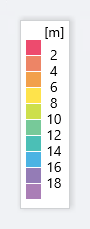
Shows the legend for the Associated Client View.
The legend can be made invisible or visible by using the checkbox in the floor map control section at the bottom of the page.
Section 5
The heatmap display in "Drawing Mode" is only reflected when an individual radio band is selected in the radio band drop-down list in the header.

| Item Name | Description |
|---|---|
| Drawing Mode | Lets you select what to show on the heatmap. The options are: Comfort Level, Power (signal strength) and Channel. The default is "Comfort Level". |
| Grid | Lets you enable or disable grid lines on the floor map. Checking this shows grid lines on the floor map. |
| Legend | Lets you enable or disable the legend. Check to display. |
| Details | Whether to display the Wireless Client List. Check to display. |
| Floor Area | This item is not supported. |
| Wall | If walls have been created on the floor map (using the Edit Wall page), lets you choose whether to display the walls. Check to display. |
| Opacity | Specify the opacity of the floor map background image. |
Section 6
Zoom In/Out buttons.
You can zoom in (+) or zoom out (-) of the floor map display. You can also use the mouse wheel scroll to zoom in or out.

Wireless Client List (Detail)
Clicking "Details" at the top of the client list in the "Wireless Client View" extends the list to show additional information including system information, wireless information and statistics.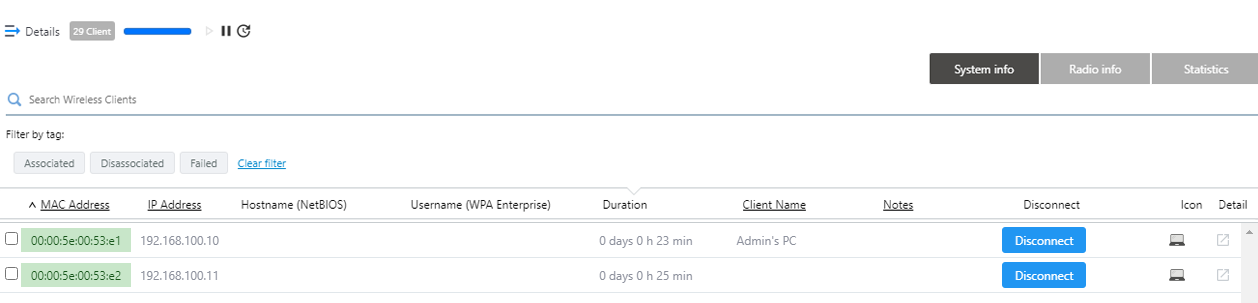
| Item Name | Description |
|---|---|
| Details | Clicking this shows extra data, including the SSID, Associated AP and connection Duration, in addition to the default items (IP and MAC addresses). Clicking this again returns you to the default non-detailed view. |
| X Client | Shows the number of clients connected to the AP that is selected on the floor map. |
| Refresh Timer | Shows the status of the timer that automatically refreshes the page with the blue progress bar. The list is updated at the interval set for "Floor Map (Wireless Client)" in the "Refresh Rates" in the User Management menu (default: 5 seconds). You can also specify whether to pause or resume automatic updates by clicking Resume/Pause automatic update button on the right, or force the wireless client list to be updated by clicking the Manual update button. |
| "System Info" / "Wireless Info" / "Statistics" buttons | Switches the contents of the list. |
| System Info | |
| Search Wireless Clients | Entries in the list can be filtered by entering a partial string in the search box. The Search field lets you enter a partial string to match. The screen displays entries with that string in one of the following fields: "MAC Address", "IP Address", "SSID" or "Associating AP". To remove the filter, delete the string from the search field and press enter. NoteThe search is case-sensitive. |
| Filter by tag | Narrow down the list of wireless clients by client status.
|
| Checkbox | Lets you select wireless clients to be shown on the floor map. When you select a client, an icon and the MAC address of the client are shown near the AP with which the client is associated. A selection made through the detailed list view will remain when you go back to default (simpler) client list view. |
| MAC Address | Shows the MAC address of the wireless client. The background color of the MAC address also indicates the status of the wireless client.
|
| IP Address | Shows the IP address of the wireless client. |
| Hostname (NetBIOS) | Shows the NetBIOS host name of the wireless client. |
| Username (WPA Enterprise) | Shows the RADIUS username when using WPA Enterprise. |
| Duration | Shows the time duration for which the client has been connected to the AP.NoteMake sure that the clock on the computer for browsing is set to the same date and time as the Vista Manager EX server settings. If you set a different time, the duration of wireless clients may not be displayed correctly. |
| Client Name | Shows the Client Name if defined in the "Client Definition List" dialog box. |
| Notes | Shows any comments entered in the "Client Definition List" dialog box. |
| Disconnect | Disassociates the wireless client connection. If the AP which the client is associated to supports instant disassociation, the "Disconnect" button will be shown. By clicking "Disconnect", you can immediately kick out the wireless client. NoteYou cannot select and disconnect multiple clients simultaneously. Please click the "Disconnect" button of each client. NoteThe feature is supported with TQ5403, TQ5403e, and TQm5403 firmware version 6.0.1-1.x or later; with TQ1402 and TQm1402 firmware version 6.0.0-0.x or later; or TQ6602 firmware version 7.0.0 or later. NoteIf the client device is set to connect automatically to the SSID, the client will be associated soon again after the disassociation. If you want to deny a specific client device permanently, consider using another authentication method such as MAC Access Control. |
| Icon | Displays the wireless client icon shown on the floor map. If the wireless client is currently associated:
|
| Details | The "Wireless Client Detail" screen will appear in a new tab or window in your web browser. |
| Radio info | |
| MAC Address | Shows the MAC address of the wireless client. |
| SSID | Shows the SSID the client is associated with. |
| Associating AP | Shows the device name of the AP the client is associated with. |
| RSSI | Displays the Received Signal Strength Indicator (in dBm) from the wireless client. |
| Noise | Shows the strength of the noise that is interfering with the client communication. |
| SNR | Shows the Signal to Noise Ratio. A larger SNR means there is less noise influence. |
| Details | The "Wireless Client Detail" screen will appear in a new tab or window in your web browser. |
| Statistics | |
| MAC Address | Shows the MAC address of the wireless client. |
| Tx Packets | Shows the number of the packets sent to the client. |
| Tx Bytes | Shows the total size of the packets sent to the client. |
| Tx Drop Packets | Shows the number of discarded packets to be sent to the client. |
| Tx Drop Bytes | Shows the number of discarded bytes to be sent to the client. |
| Rx Packets | Shows the number of the packets received from the client. |
| Rx Bytes | Shows the total size of the packets received from the client. |
| Rx Drop Packets | Shows the number of received packets which were discarded. |
| Rx Drop Bytes | Shows the number of received bytes which were discarded. |
| Details | The "Wireless Client Detail" screen will appear in a new tab or window in your web browser. |
Note"Noise Level", "SNR", "Transmit Packets Discarded", "Transmit Bytes Discarded", "Received Packets Discarded" and "Received Bytes Discarded" are not supported in this version.
Client Definition List
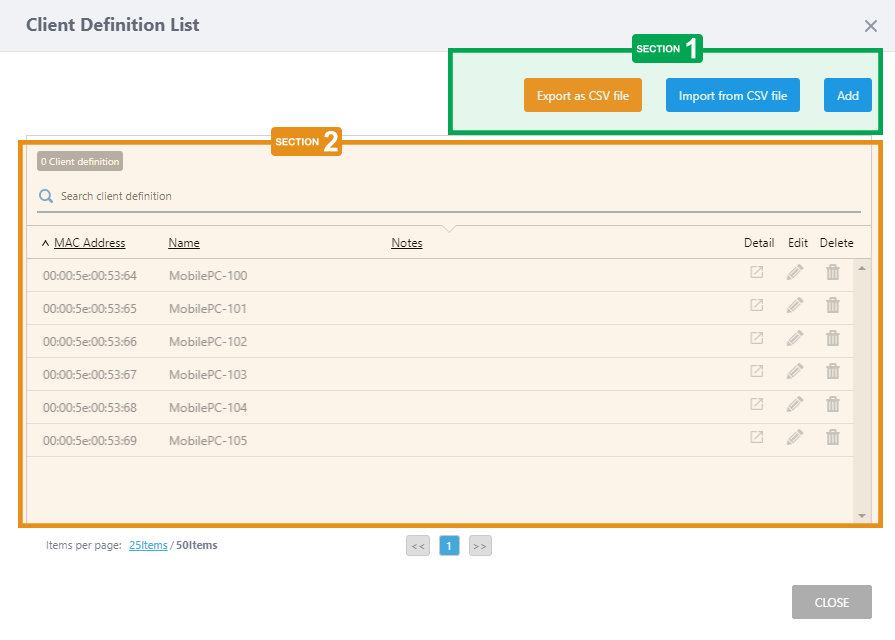
With this list, you can define display names and notes for specific clients to help with identification in the Wireless Client View.The client names will be used only in the Wireless Client View. The Management Log screen will not be affected.
Section 1
| Item Name | Description |
|---|---|
| "Export as CSV file" button | Exports registered client definition to a CSV (Comma-Separated Values) format file. |
| "Import from CSV file" button | The "Import from CSV" dialog box will appear.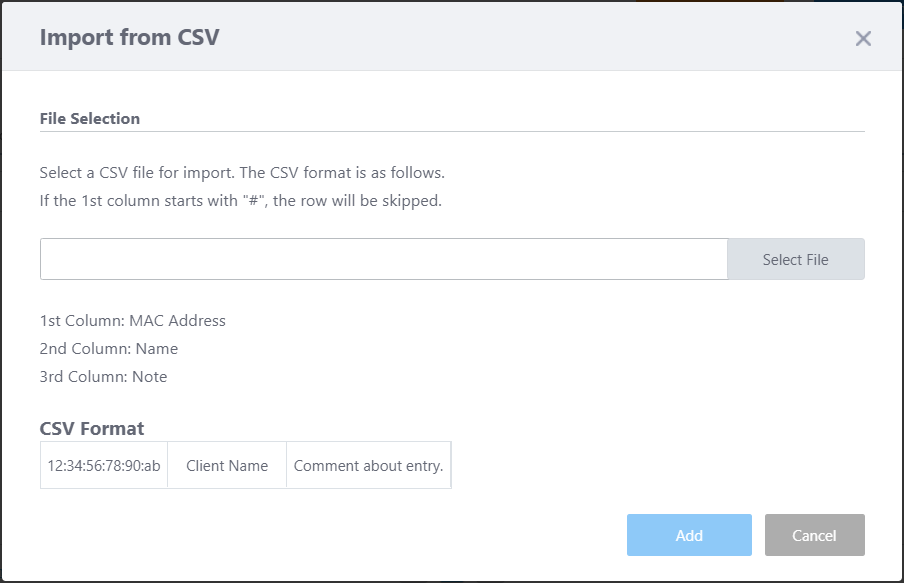
|
| "Add" button | Shows the "Add client definition" dialog box.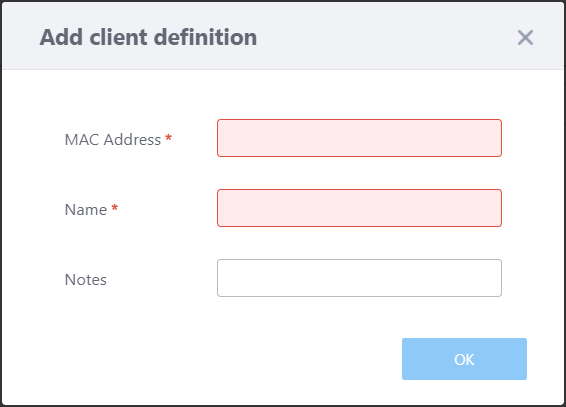
|
Section 2
| Item Name | Description |
|---|---|
| X Client definition | Shows the total number of client definition entries. |
| Search client definition | Lets you search client definition entries. The Search field lets you enter a partial string to match. The screen displays entries with that string in one of the following fields: "MAC Address", "Name" or "Notes". To remove the filter, delete the string from the search field and press enter. NoteThe search is case-sensitive. |
| MAC Address | Shows the defined MAC address. |
| Client Name | Shows the defined display name of the client. |
| Notes | Shows any comments you entered about the client definition. |
| "Details" button | The "Wireless Client Detail" screen will appear in a new tab or window in your web browser. |
| Edit (pencil icon) | Shows the "Add client definition" dialog box.
|
| Delete (trashbin icon) | Deletes the client definition. |
Wireless Client Detail
Displays information about wireless clients that have associated with the managed AP or failed to associate to the managed AP.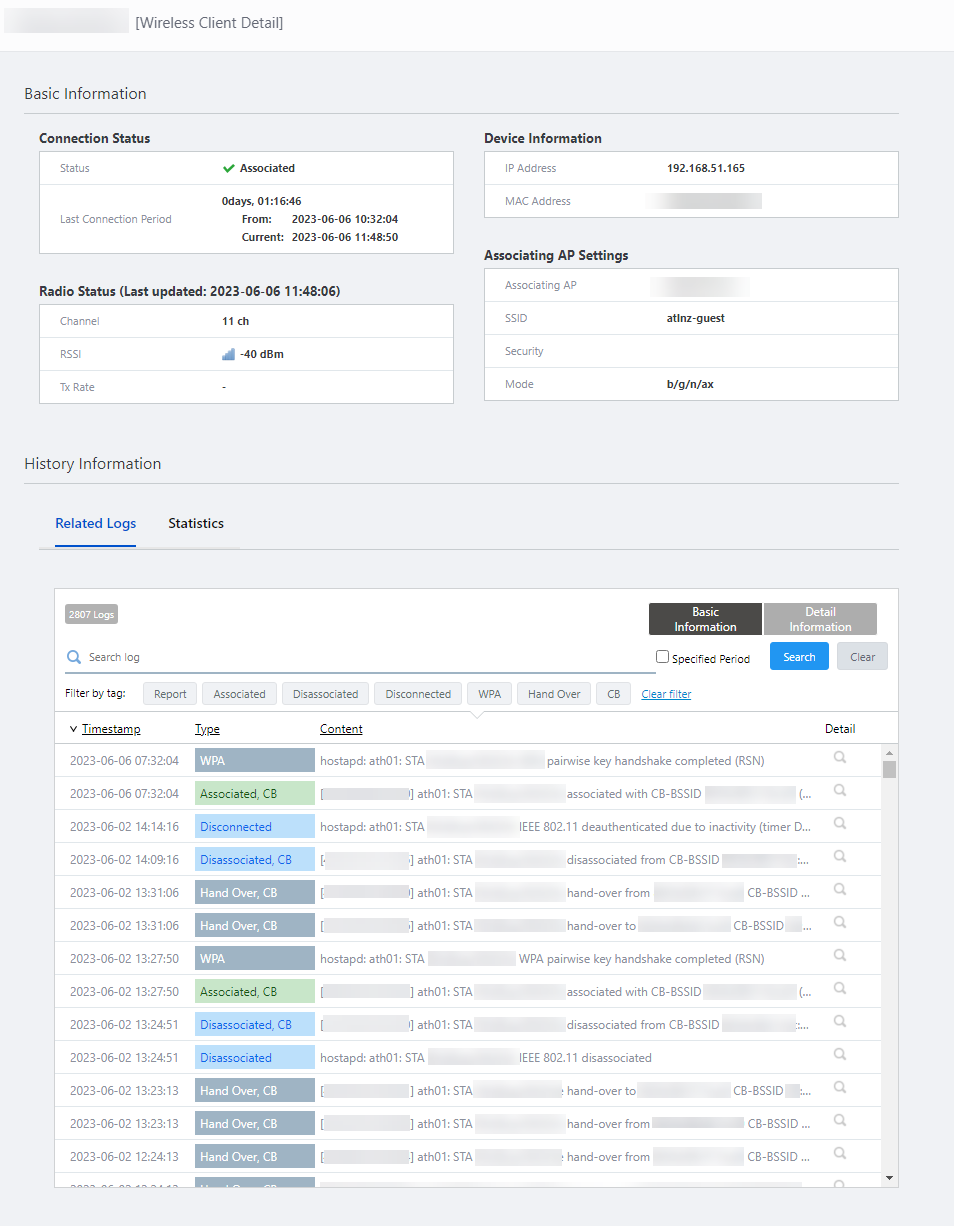
NoteItems of Basic Information, except for Connection Status, are displayed only when the wireless client is currently connected.
| Item Name | Description |
|---|---|
| Basic Information | |
|
|
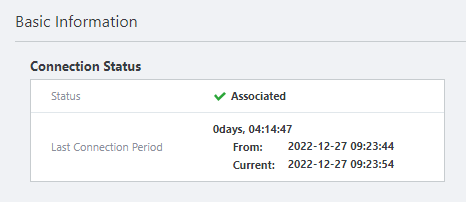
| Connect Status | |
| Status | Displays the current status (at the time the screen is displayed) of the wireless client in question. |
| Last Connection Period | Displays the elapsed time for connection, connection start/end date and time when the wireless client was last connected to the managed AP. |
| Radio Status (Last updated: YYYY-MM-DD hh:mm:ss) | |
| Channel | Displays connected channel. |
| RSSI | Displays the Received Signal Strength Indicator (in dBm) from the wireless client. |
| Tx Rate | Displays the data transmission rate (in kbps or Mbps) of the wireless client. |
| Device Information | |
| IP Address | Shows the client's IP address. |
| MAC Address | Shows the device MAC address. |
| Associating AP Settings | |
| Associating AP | Shows the name of the AP that the wireless client is associating. |
| SSID | Shows the connected SSID. |
| Security | Shows the security method of the wireless connection. |
| Mode | Shows the radio mode of the wireless connection. |
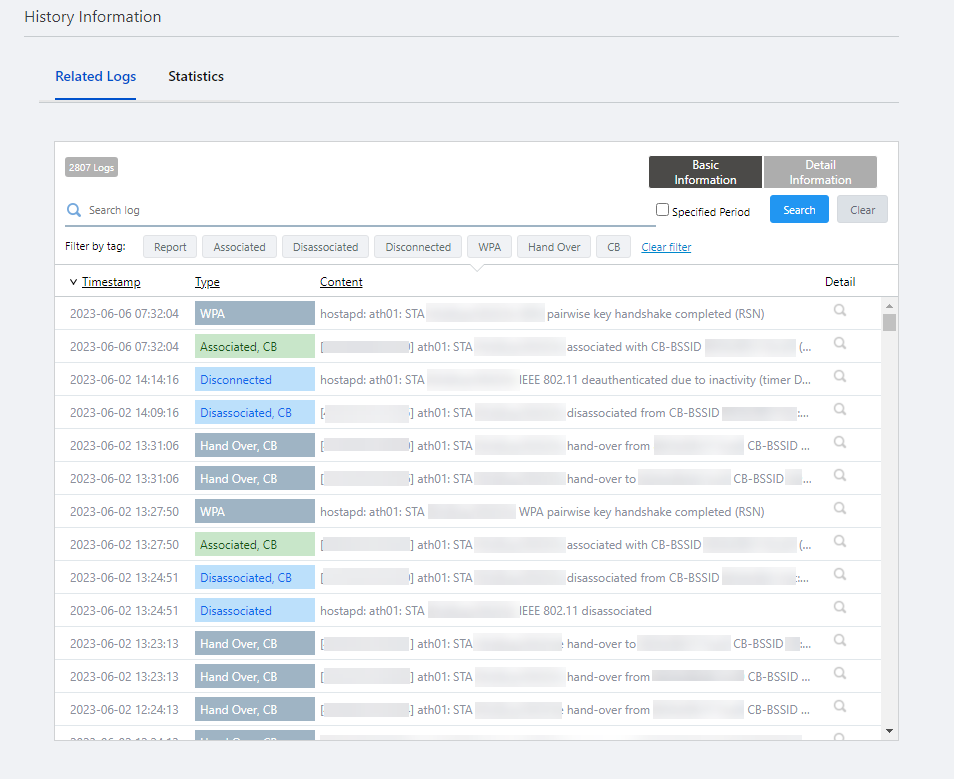
| History Information | |
|
|
| Related Logs | |
| X Logs | Displays the current number of relevant logs for the AP in question to be displayed. |
| Basic Information / Detail Information | Switches the contents of the list. |
| Search Log | Filter entries in the list by entering a partial string in the search box. The search field lets you enter a partial string to match. The screen displays entries with that string in one of the following fields: "Timestamp", "Type" or "Content". To remove the filter, delete the string from the search field and press enter. |
| Specified period | Check this box if you want to specify a specific period in the log history to be displayed in the list. When checked, you can specify the start and end date and time of the specified period using the calendar control or manually. Specify the period and click the "Search" button to reflect it in the list. |
| "Search" button | Searches the history of logs that match the criteria for the "Specified Period". |
| "Clear" button | Clears the filtering criteria entered in "Search log" or by "Specified Period". |
| Filter by tag | Lets you narrow down the events by their types, "Management Status", "Apply Configuration", "Maintenance", "AWC Calculation", "Report", "AWC System", "Wireless AP Unit", "Failed", "Associated", "Disassociated", "Multiple Connection Request", "WPA", "IEEE 802.1x", "RADIUS", "Handover", "DFS", "CB", "SC", "Captive Portal", or "Others". If multiple items are specified, logs matching any of the filters will be displayed (OR search). By clicking "Clear filter", the filter will be back to unspecified. |
| Related Logs: Basic Information | |
| Timestamp | Shows the date and time when the event occured. |
| Type | Shows the event type. |
| Content | Shows the content of the log entry. |
| Details | "Wireless AP Log Detail" dialog box will be displayed. |
| Related Logs : Detail Information | |
| Timestamp | Shows the date and time when the event occured. |
| Type | Shows the event type. |
| SSID | Displays the SSID of the VAP from which the association or disassociation took place. |
| BSSID | Displays the BSSID of the VAP from which the association or disassociation took place. |
| Model Name | Displays the model name of the managed AP that detected the event. |
| Floor Map | Displays the name of the floor map where the managed AP that detected the event is located. |
| Details | "Wireless AP Log Detail" dialog box will be displayed. |
| Statistics Information | |
| Wireless Connection Log Graph | The graph shows the number of wireless connection-related logs associated with the wireless client in question, as a stacked bar graph of connections, disconnections, and connection failures. By default, the period displays daily graphs for the last 5 days. Clicking on any of the date bars in the graph will display an hourly graph for that day, and clicking on any of the hour bars in the graph will display a five-minute basis graph for that hour. To return to a graph with a longer time period than the one currently displayed, click on the time period in the upper left corner of the graph. |
| Traffic Graph | The number of bytes received by wired connection (upper vertical axis), and the number of bytes sent by wireless connection (lower vertical axis), are displayed in a stacked bar graph. By default, the period displays daily graphs for the last 5 days. Clicking on any of the date bars in the graph will display an hourly graph for that day, and clicking on any of the hour bars in the graph will display a five-minute basis graph for that hour. To return to a graph with a longer time period than the one currently displayed, click on the time period in the upper left corner of the graph. |
Wireless Client Log Detail
Displays the selected log details for wireless client.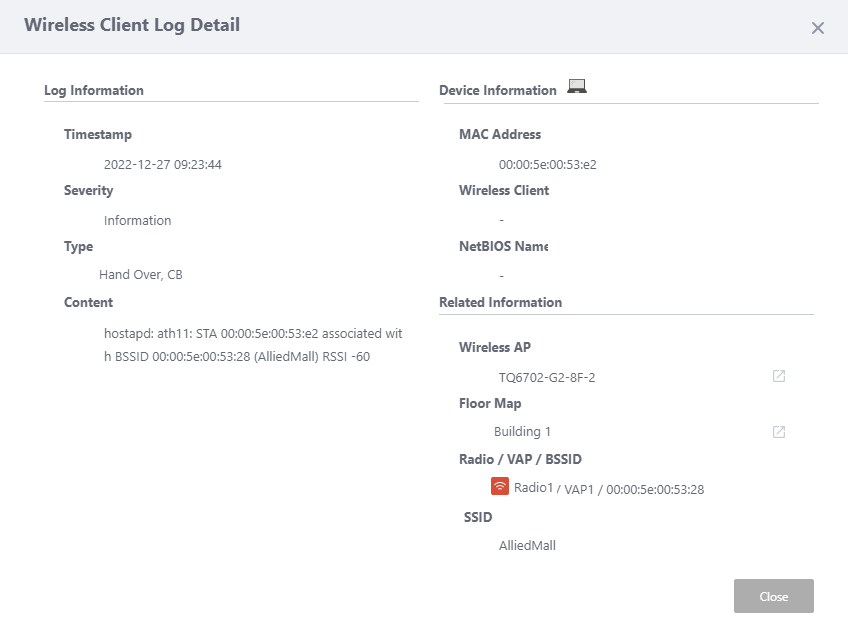
| Item Name | Description |
|---|---|
| Log Information | |
| Timestamp | Shows the date and time when the log entry was received. |
| Importance | Shows the importance of the log. |
| Type | Shows the event type. |
| Content | Shows the content of the log. |
| Device Information | |
| Wireless Client icon | Displays the icon used to represent the wireless client on the floor map. |
| MAC Address | Shows the MAC address of the wireless client. |
| Client Name | Shows the Client Name if defined in the "Client Definition List" dialog box. |
| NetBIOS Name | Shows the NetBIOS host name of the wireless client. |
| Related Information | |
| Wireless AP | Shows the name of the AP which recorded the Log. |
| "Wireless AP Detail" button | Display the Wireless AP Detail screen for the relevant AP in a new tab or window in your web browser. |
| Floor Map | Displays the name of the floor map where the AP is located. |
| Floor Map Detail button | Displays the Floor Map Details [Wireless Status View] screen of the floor map where the relevant AP is located in a new tab or window in your web browser. |
| Radio / VAP / BSSID | Displays the Radio, VAP number, and BSSID of the relevant VAP for which the wireless client has associated, disassociated, or failed. |
| SSID | Displays SSIDs of VAP to which the corresponding wireless client has associated, disassociated, or failed. |
12 Jul 2024 09:31