Wireless Concierge
The wireless concierge suggests optimizing the channel and transmit power of cell-based (non-blanket) VAPs of wireless APs on the same floor map and the CB VAPs of wireless APs that join the AWC-CB under management.
There are three types of optimization suggestions, and for each selected floor map or AP, the user can select, request, and apply suggestions for each item.
- Interference Reduction (suppression of overlapping wireless channels)
- Coverage Control (suppression of radio output power)
- AP thinning (stopping wireless output of redundant wireless APs)
You can also set up automatic coverage complementation by AWC-SAC (AWC-Smart ACtivation).
AWC-SAC regularly monitors the wireless output during operation and detects failures with two functions: Coverage Control and Rogue AP Interference Monitor.
- Coverage Control
This feature enables standby APs to be activated according to the network coverage status and repairs coverage holes.
The coverage status of each floor is monitored every 20 seconds. If there is any change in the managed AP status or coverage status, the system notifies the user by an event message, or automatically executes the coverage complement described above.
- Rogue AP Interference Monitor
Interference levels on each floor are periodically monitored on an hourly basis and prompts you when re-optimization is needed.
If the configured threshold is exceeded, an event message will be sent.
Note that AWC-CB is not supported in TQ1402 and TQm1402/5403. Therefore AWC-CB optimization is also not supported.
◼ Automatic repair of coverage holes with AP Thinning and Coverage Control
AWC-SAC coverage control is a function that can be used in conjunction with suggestions of AP Thinning to simplify the redundancy of wireless networks.
By simply deploying a sufficient and extra number of wireless APs, a redundant configuration can be automatically established, eliminating the need for detailed network design and on-site surveys, and reducing initial installation and operation costs.
When installing, perform the AP Thinning suggestion to detect "excess APs" and set them to standby state with 0% transmit power. This allows the network to be operated with an appropriate density of wireless APs during normal times, without the need for individual adjustments.
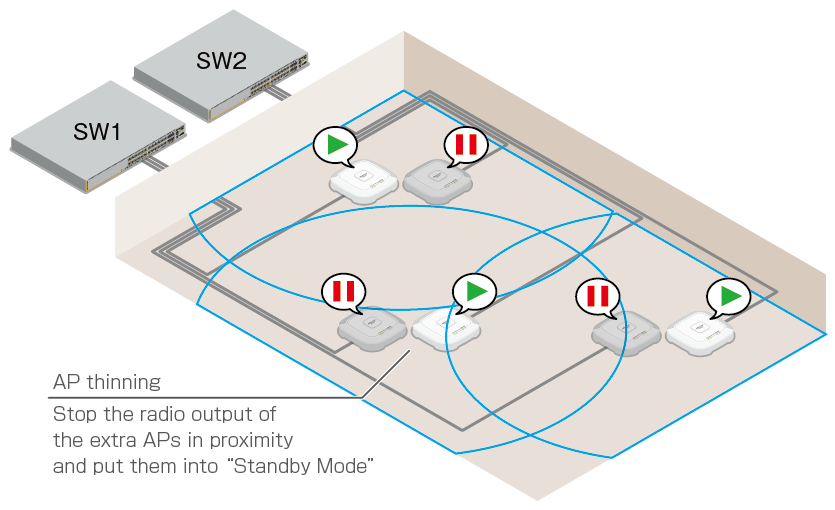
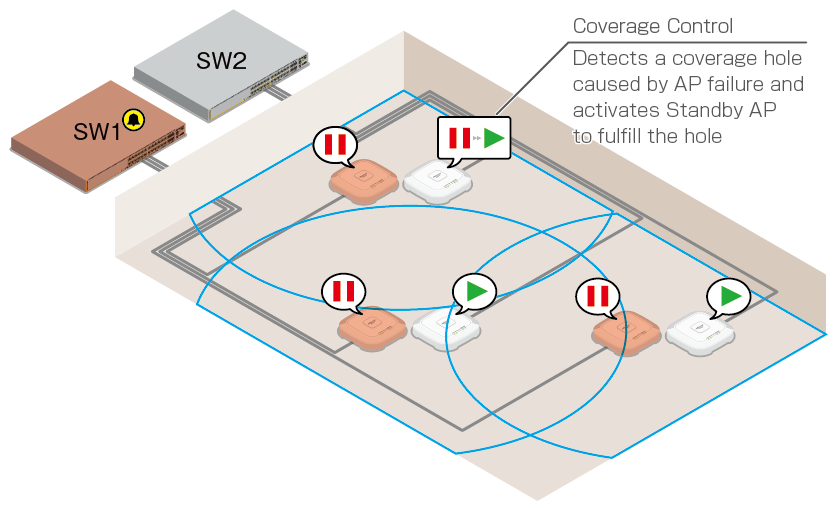
NoteIt is recommended that the active and standby wireless APs be connected to separate power supplies or PoE switches, especially at locations where the need for wireless networking is high.
Wireless Concierge
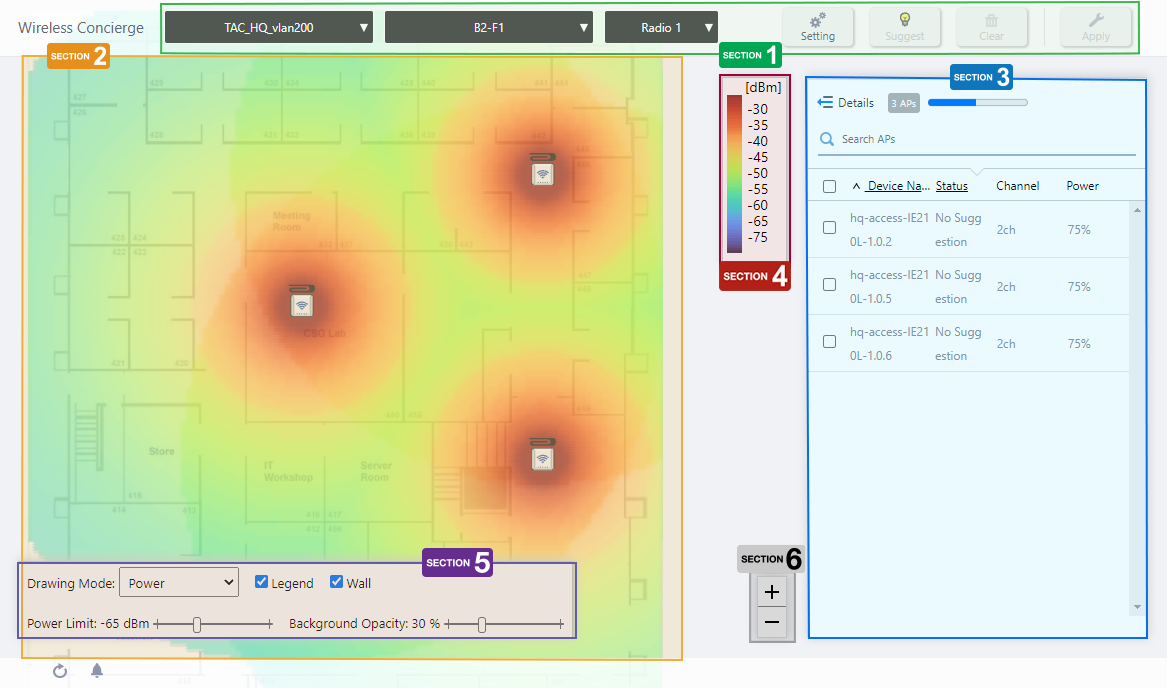
Section 1
You can select a target management group and floor map, set the type of suggestion, request, delete, or apply the suggestion.
| Item Name | Description |
|---|---|
| Management group drop-down menu | Narrow down the floor map to be displayed. The default is "All Management Groups". |
| Floor Map drop-down menu |
Select the floor map to be configured. The default is "All Floor Maps". When you select one of the floor maps, the management group drop-down menu will be set to its corresponding floor map. The panel view of the floor map will also switch to the floor map detail view. It also selects all floor maps that have wireless APs with the same CB VAP applied to them. To return to the floor map panel view again, select "All Floor Map". |
| Radio dropdown menu | Lets you select a radio band to show on the map, from Radio 1, 2 or 3. |
| "Setting" button |
Displays the Suggest - Setting dialog box. In the " Suggest - Setting" dialog, you can select the type of optimization suggestion for each floor map or channel blanket under your management. You can also configure the management and notification functions of AWC-SAC here. |
| "Suggest" button |
Displays the Suggest - Execution dialog box. In this dialog box, request optimization suggestions for the target selected in the floor map list or wireless AP list, for each radio band (2.4GHz, 5GHz). |
| "Clear" button |
Clears the status of current suggestions for the selected floor maps or wireless APs and returns it to the "No suggestion" status. Changes made by applied suggestions will not be reverted. |
| "Apply" button |
Displays the Apply - Execution dialog box. This dialog box applies the optimization suggestions to the wireless APs on the floor map selected in the floor map list or in the wireless AP list. |
Section 2
Floor map panel view, floor map layered view, and floor map detailed view will be displayed depending on the selection of the suggestion target.
- Panel View
The panel display of the floor map will appear in the following cases:
- If you have not selected a specific management group in the drop-down menu at the top of the screen.
- When a specific management group is selected in the drop-down menu at the top of the screen, and a specific floor map is not selected in either the drop-down menu or the floor map list on the right side of the screen.
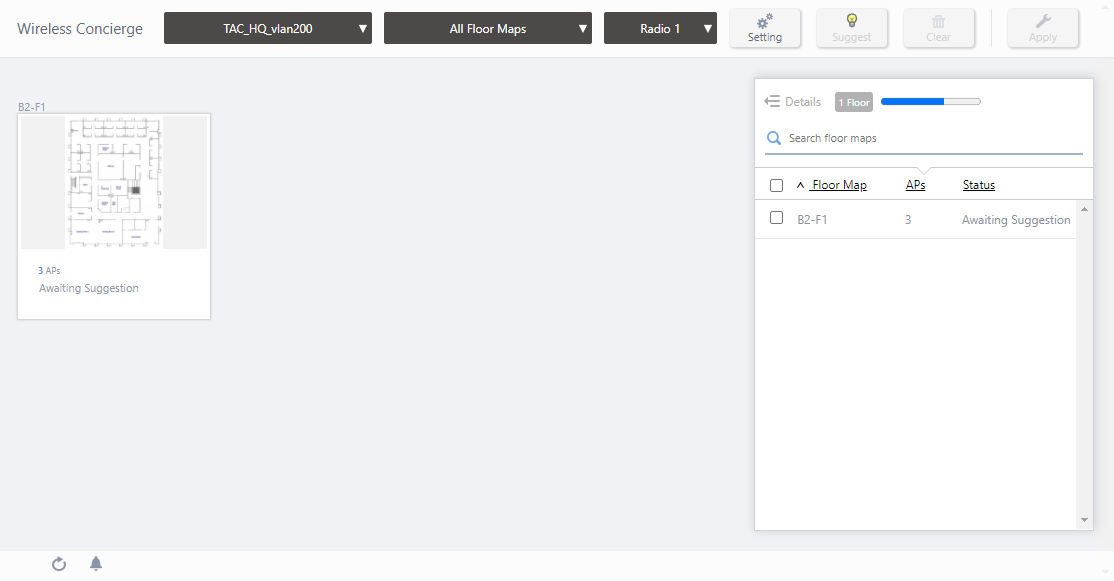
- If you have not selected a specific management group in the drop-down menu at the top of the screen.
- Layered View
A layered 3D view of the floor map will be displayed in the following case:
- When a specific management group is selected in the drop-down menu at the top of the screen, no specific floor map is selected in the floor map drop-down menu, and any floor map is selected in the floor map list on the right side of the screen.
When you place your mouse cursor on an AP on the floor map, management information of the AP will pop up.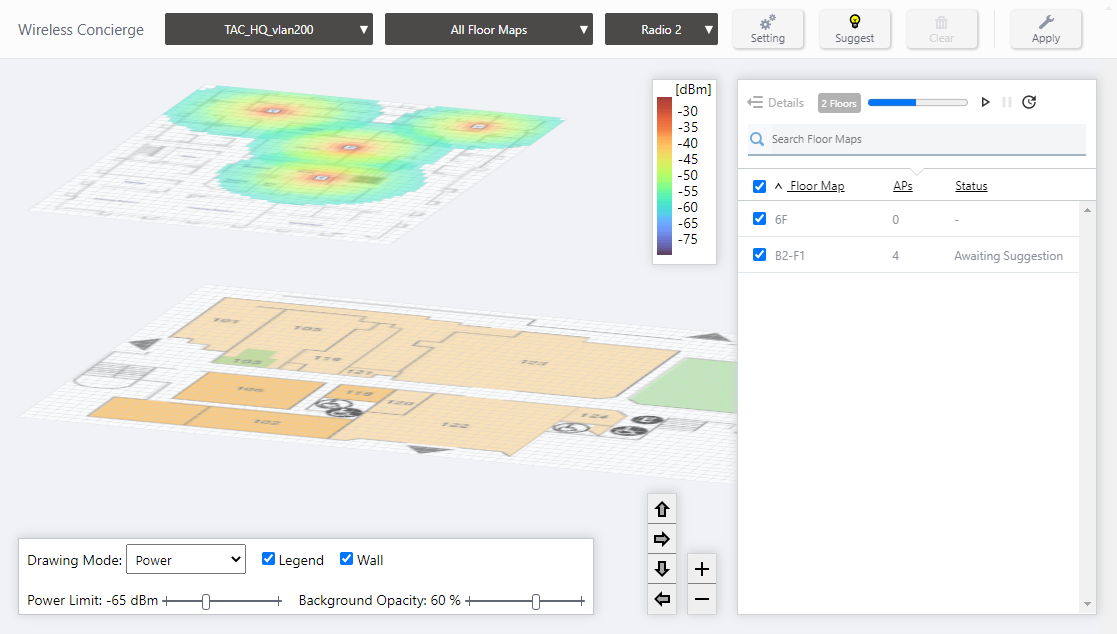
- IP Address
- MAC Address
- Device Name
Note
The order of the stacked floor maps is displayed in ascending order by the character code of the floor map name, starting from the bottom. This cannot be rearranged.
- When a specific management group is selected in the drop-down menu at the top of the screen, no specific floor map is selected in the floor map drop-down menu, and any floor map is selected in the floor map list on the right side of the screen.
- Detailed View
A detailed view of the floor map will be displayed in the following case:
- If you have selected a specific floor map in the floor map drop-down menu at the top of the screen.
- When you select a specific floor map panel in the Panel View.
When you place your mouse cursor on an AP on the floor map, management information of the AP will pop up.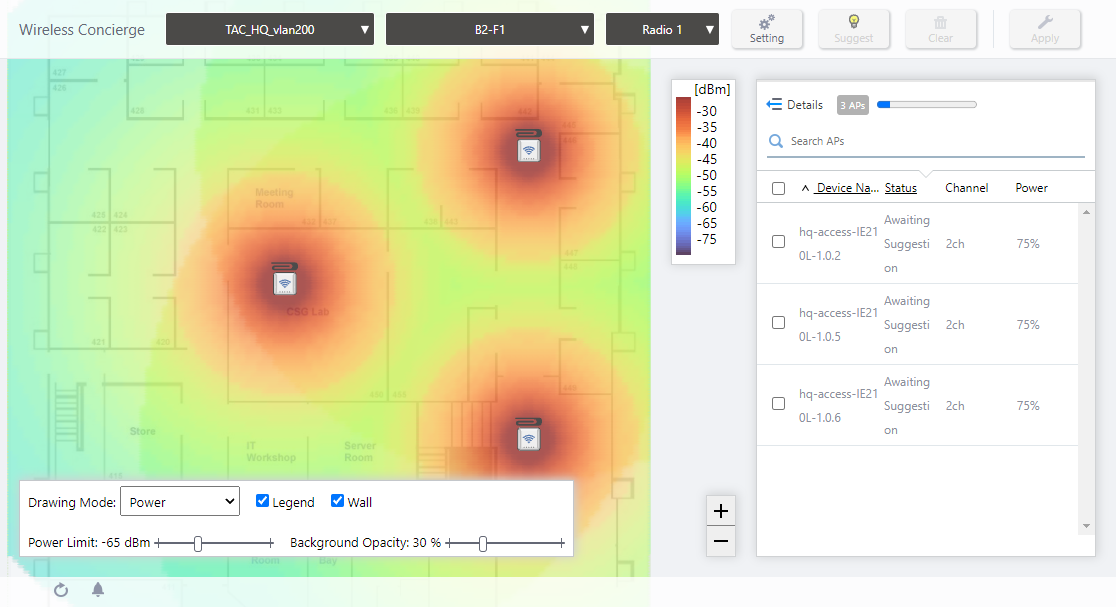
- Device Name
- Used channels, bandwidth, and output strength of the currently displayed radio band.
- If you have selected a specific floor map in the floor map drop-down menu at the top of the screen.
Section 3
Depending on the selection of the suggestion target, the floor map list or the wireless AP list will be displayed.
- Floor Map List
If you have not selected a specific floor map in the floor map drop-down menu at the top of the screen, the floor map list will be displayed.
- AP List
If you have selected a specific floor map in the floor map drop-down menu at the top of the screen, a list of wireless APs will be displayed.
Section 4
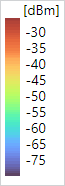
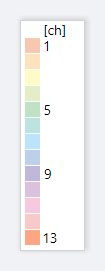
This is a legend of the heat map display in the floor map layered view or the floor map detailed view.
It shows the relationship between colors and signal strength or channels.
The legend can be made invisible or visible by using a checkbox in the floor map control section at the bottom of the page.
Color conventions depend on the floor map drawing mode.
- Power
- Channel
Section 5

| Item Name | Description |
|---|---|
| Drawing Mode | Lets you select what to show on the heatmap. Options are power (signal strength) and channel. |
| Legend | Lets you enable or disable the legend. Check to display. |
| Wall |
If walls have been created on the floor map (using the Edit Wall page), this lets you choose whether to display the walls. Check to display.NoteIf walls have been defined, attenuation by the walls takes effect on the heat map even when this control is left unchecked. |
| Power Limit | Specify the minimum signal strength to show in colors on the heatmap. |
| Opacity | Specify the opacity of the floor map background image. |
Section 6
Adjusts the display size and angle of the map.
- Zoom In/Out buttons
You can zoom in (+) or zoom out (-) of the floor map display. You can also use the mouse wheel scroll to zoom in or out.

- Angle adjustment buttons
Only in the layered view, the angle at which the floor map is displayed can be adjusted using the arrow buttons.
- Up/Down arrows: Adjust the vertical (pitch) angle.
- Left/Right arrows: Adjust the horizontal rotation (yaw) angle.
- Up/Down arrows: Adjust the vertical (pitch) angle.
Floor Map List
Displays the status of the suggestions for floor maps that belong to the selected management group.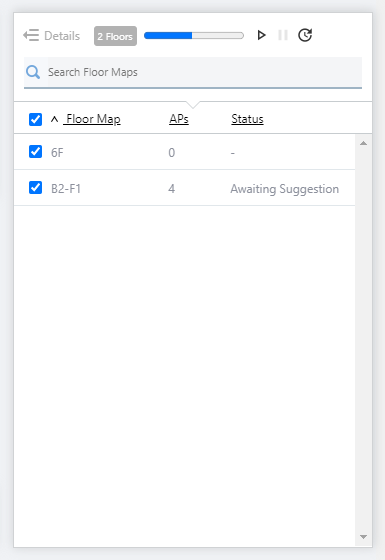
| Item Name | Description |
|---|---|
| Details | This is not available in the floor map list view. |
| X Floors |
Displays the current number of floor maps to be shown. If you have narrowed down the search in "Search floor maps", the number of matching floor maps will be displayed. If you have not narrowed down the search, the total number of floor maps belonging to the management group selected in the drop-down menu at the top of the screen will be displayed. |
| Refresh Timer |
Shows the status of the timer that automatically refreshes the page with the blue progress bar. The list is automatically refreshed at the interval configured on "Refresh Rates" > "Floor MAP (Wireless Status)" in the User Management menu. (The default is 1 minute.) In the layered floor maps view, the resume/pause automatic update buttons and the manual update button are displayed along with a progress bar. By default, automatic updates are paused. |
| Search Floor Map |
You can search for floor maps that belong to a management group. Displays the items among the current display targets that contain the string entered in this field in the floor map name. To remove the filter, delete the string from the Search field and press Enter. NoteThe search is case-sensitive. NoteThis item is disabled in the layered floor maps. |
| Floor Map |
Displays the name of the floor map that belongs to the management group. To execute, apply, or clear a suggestion, check the checkbox to the left of the floor map name. Also, placing the mouse pointer on any row in the floor map list will highlight the corresponding floor map among the layered floor maps. |
| APs | Displays the number of wireless APs deployed on the corresponding floor map. |
| Status |
Displays the status of the optimization suggestion for the corresponding floor map.
|
AP List
Displays the state of suggestions for wireless APs deployed in the selected floor map.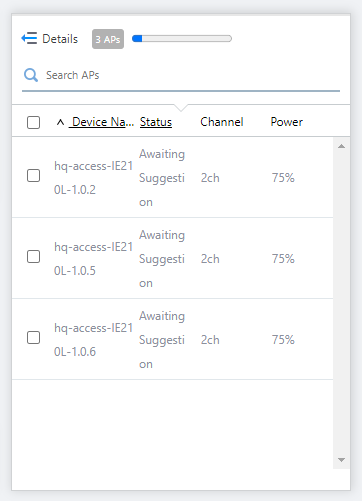
| Item Name | Description |
|---|---|
| Details |
Clicking on it displays the default floor map name and status, radio information such as country code, channel specification, bandwidth, transmit power specification applied to the wireless AP, system information such as model name, MAC address, IP address, AP profile, CB profile/CB name, and SC profile. Clicking Details again returns you to the default non-detailed view. |
| X APs | Displays the total number of wireless APs deployed on the floor map. |
| Refresh Timer | Shows the status of the timer that automatically refreshes the page with the blue progress bar. The list is automatically refreshed at the interval configured on "Refresh Rates" > "Floor MAP (Wireless Status)" in the User Management menu. (The default is 1 minute.) |
| Search Wireless AP |
You can search for wireless APs located on the floor map. Of the current display targets, "Device Name", "Bandwidth", "Model", "MAC Address", "IP Address", or "AP Profile" will display items that contain the string entered in this field. To remove the filter, delete the string from the Search field and press Enter. NoteThe search is case-sensitive. |
| Device Name |
Displays the names of wireless APs placed on the floor map. When executing, applying, or clearing a suggestion, check the box to the left of the device name. |
| Status |
Displays the status of the optimization suggestion for the corresponding APs.
|
| Channel | Displays the channel for the selected radio band. |
| Tx Power | Displays the transmit power of the selected radio band. |
AP List (Detail)
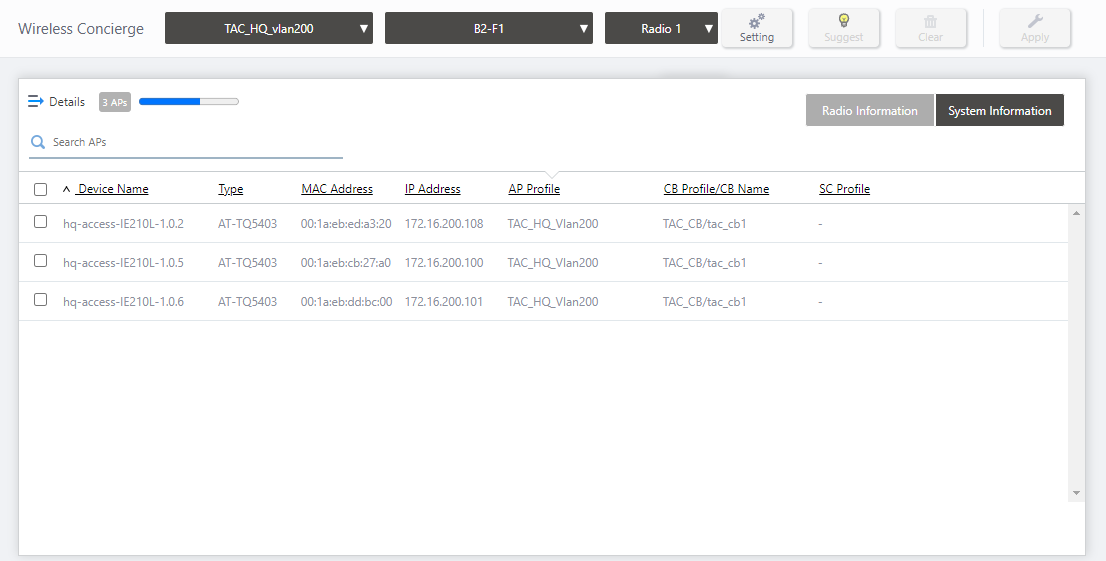
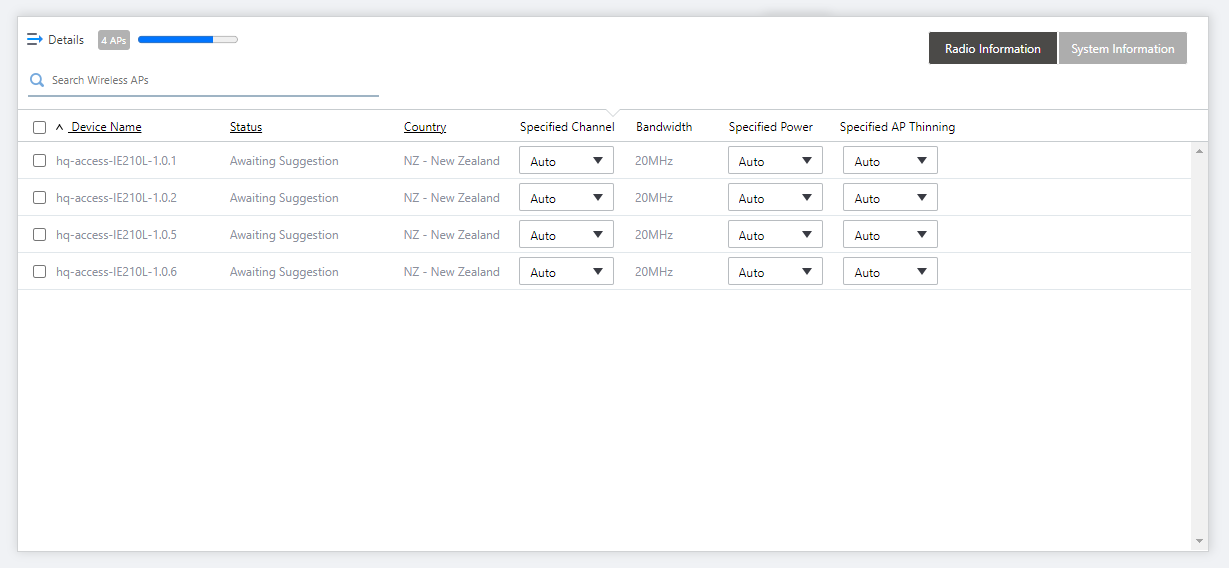
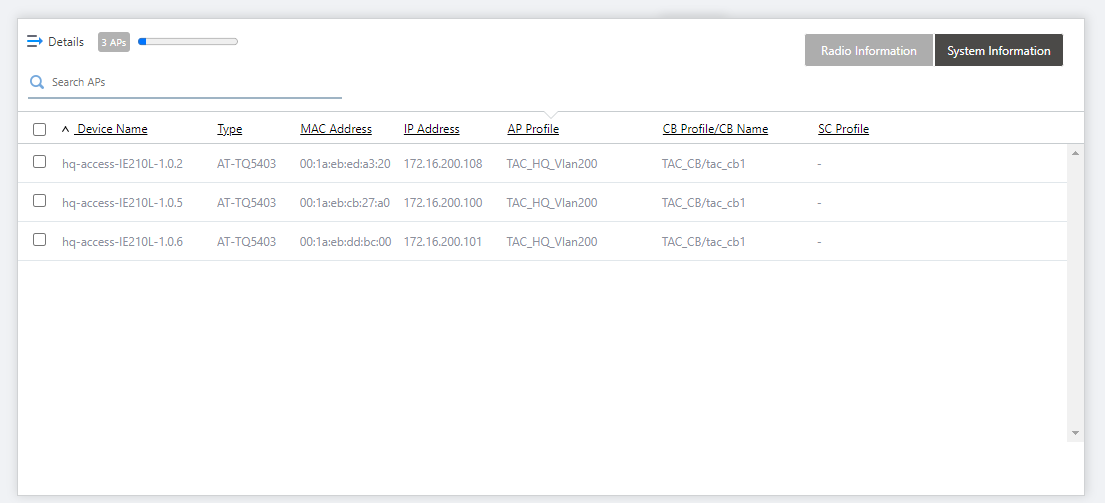
Click "Details" at the top of the AP list to expand the list and display information such as models, AP profiles, etc.The list can be switched between radio information and system information of the wireless APs. In the initial state, wireless information of the wireless APs is displayed.
| Item Name | Description |
|---|---|
| Details | Clicking "Details" again on the extended list shrinks the list to its default size. |
| X APs | Displays the total number of wireless APs deployed on the floor map. |
| Refresh Timer | Shows the status of the timer that automatically refreshes the page with the blue progress bar. The list is automatically refreshed at the interval configured on "Refresh Rates" > "Floor MAP (Wireless Status)" in the User Management menu. (The default is 1 minute.) |
| "Wireless Information" button | Switches the list content to the wireless configuration of the APs placed on the floor map. |
| "System Information" button | Switches the list content to system information for the APs placed on the floor map. |
| Search Wireless AP |
You can search for wireless APs located on the floor map. Of the current display targets, "Device Name", "Bandwidth", "Model", "MAC Address", "IP Address", or "AP Profile" will display items that contain the string entered in this field. To remove the filter, delete the string from the Search field and press Enter. NoteThe search is case-sensitive. |
| Radio info | |
 |
|
| Device Name |
Displays the names of wireless APs placed on the floor map. When executing, applying, or clearing a suggestion, check the box to the left of the device name. |
| Status |
Displays the status of the optimization suggestion for the corresponding APs.
|
| Country | Displays the country code (regulated area of the radio frequency band) set for the wireless AP. |
| Specified Channel |
You can specify the radio channel for the selected radio band from the drop-down list. The drop-down list shows the channel candidate or automatic selected in the AP profile Auto Channel Selection. Among the channel candidates, the currently applied channel will be shown in blue. The default is "Auto". NoteIf the Bandwidth is 80+80MHz, no channel can be specified. It will be selected automatically. |
| Bandwidth | Displays the bandwidth for the selected radio band. |
| Specified Power |
You can select the transmit power of the selected radio band from the drop-down list. From the drop-down list, you can choose Auto, 1%, 5%, 10%, 20%, 30%, 40%, 50%, 60%, 70%, 80%, 90%, or 100%. The default is "Auto". |
| Specified AP Thinning |
Individually configures "AP Thinning" which sets the wireless output to 0% and puts it in standby mode. An AP in standby mode will automatically resume radio output to compensate for coverage holes caused by failure of a previously active AP.
|
| System Info | |
 |
|
| Device Name |
Displays the names of wireless APs placed on the floor map. When executing, applying, or clearing a suggestion, check the box to the left of the device name. |
| Type | Displays the model name of the AP. |
| MAC Address | Shows the MAC address of the AP. |
| IP Address | Shows the IP address of the AP. |
| AP Profile | Shows the AP Profile assigned to the AP. |
| CB Profile/CB Name | Shows the CB Profile assigned to the AP, and the Channel Blanket name to which the AP belongs. |
| SC Profile | Shows the SC Profile assigned to the AP. |
Suggest - Setting
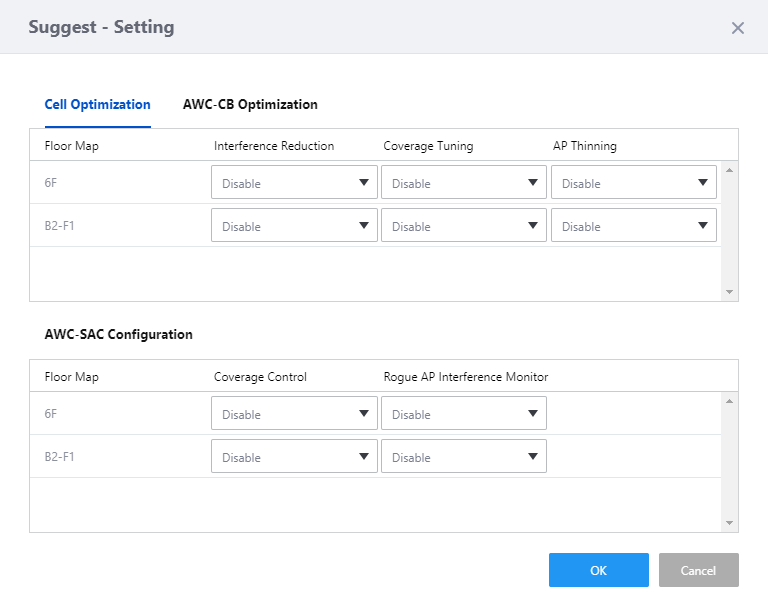
In this dialog box, choose the type of optimization suggestion for each floor map or channel blanket under your control.In addition, configure the Coverage Control by AWC-SAC and the Rogue AP Interference Monitor from here.
| Item Name | Description |
|---|---|
| Cell Optimization | |
| Floor Map | Shows the names of floor map to be configured. For the cell-based (non-Blanket) VAPs of the APs in each floor map, you can enable or disable the suggestion of Interference Reduction, Coverage Tuning, and AP Thinning. |
| Interference Reduction |
Enables or disables channel optimization.
|
| Coverage Tuning |
Enables or disables the transmit output optimization.
|
| AP Thinning |
Enables or disables "AP thinning", which sets the wireless output to 0% and puts it in standby mode.
|
| AWC-CB Optimization | |
| CB Profile/CB Name | Shows the target Channel Blanket name and its CB Profile. |
| Interference Reduction |
Enables or disables channel optimization.
|
| Overlap Reduction |
Enables or disables the transmit output optimization.
|
| AP Thinning |
Enables or disables "AP thinning", which sets the wireless output to 0% and puts it in standby mode.
|
| AWC-SAC Configuration | |
| Floor Map | Shows the names of floor map to be configured. Configure the AWC-SAC functions for the APs on each floor map. |
| Coverage Control |
Set up Coverage Control, which monitors changes in coverage, displays notifications, or automatically complements coverage by resuming the radio output of standby AP. Coverage status monitoring is performed every 20 seconds.
The following are some examples of state changes that can be monitored by Coverage Control.
NoteTo use Coverage Control, "AP Lost" and "AP Recover" event triggers for the management group must be disabled in the Wireless Configuration"/"AWC Settings screen. If either or both are enabled, detection of coverage state changes. Hence coverage control will not work. Also, if the above event trigger is set to enabled, a confirmation message will be displayed. |
| Rogue AP Interference Monitor |
Set up an Rogue AP Interference Monitor that periodically monitors channel interference caused by unmanaged (i.e., potentially "Rogue") APs and notifies the user with an event message when a certain threshold is exceeded, prompting the user to re-execute optimization. Interference by rogue APs is monitored every hour.
|
| "OK" button | Saves the changes to the type of optimization for the suggestion that you want to execute and closes the dialog. |
| "Cancel" button | Discards the changes to the type of optimization for the suggestion that you want to execute and closes the dialog. |
Suggest - Execution
In this dialog box, request optimization suggestions for the target selected in the floor map list or wireless AP list, for each radio band (2.4GHz, 5GHz).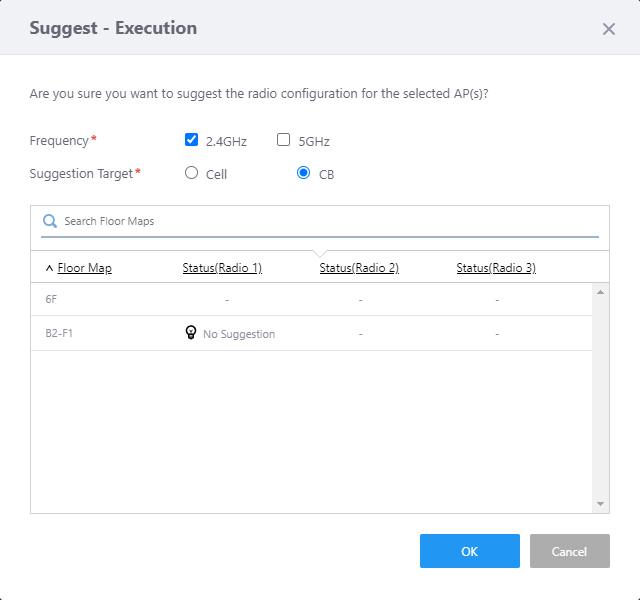
| Item Name | Description |
|---|---|
| Frequency | Select a frequency band from one or both of 2.4GHz and 5GHz to execute the suggestion. |
| Suggestion Target | Select the target for which you want to request a suggestion, either from a cell or a CB. |
| Search Floor Maps / Search APs | You can enter part of the name to narrow down the floor maps or APs to be listed. |
| Floor Map/Device Name | The name of the floor map selected in the floor map list of the Wireless Concierge screen or the name of the wireless AP selected in the AP list of the floor map detail view of the Wireless Concierge screen will be displayed. |
| Status (Radio 1 / Radio 2 / Radio 3) |
Displays the suggestions status for the floor map or wireless APs.
|
| "OK" button |
Executes the request for suggestion. Optimization suggestions are displayed in the Suggestion - Result dialog box. |
| "Cancel" button | Aborts the execution for suggestion and closes the dialog box. |
Suggest - Result
The "Suggestion - Result" dialog box shows the results of the suggestions by frequency (2.4GHz, 5GHz) selected for the floor maps or APs.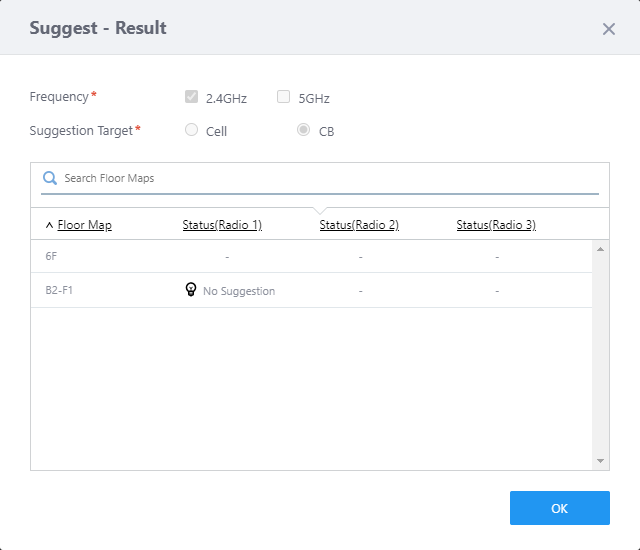
| Item Name | Description |
|---|---|
| Frequency | Displays the frequency band of the radio that requested the suggestion. |
| Suggestion Target | Select the target for which you requested a suggestion, either from a cell or a CB. |
| Search Floor Maps / Search APs | You can enter part of the name to narrow down the floor maps or APs to be listed. |
| Floor Map/Device Name | The name of the floor map selected in the floor map list of the Wireless Concierge screen or the name of the wireless AP selected in the AP list of the floor map detail view of the Wireless Concierge screen will be displayed. |
| Status |
Displays the suggestions status for the floor map or wireless APs.
|
| "OK" button |
Finishes reviewing the suggestion and closes the "Suggestion - Result" dialog box. Click the "Apply" button at the top of the Wireless Concierge screen to apply the suggestion. Then use the Apply - Execution dialog. |
Apply - Execution
This dialog box applies the optimization suggestions to the wireless APs on the floor map selected in the floor map list or in the wireless AP list.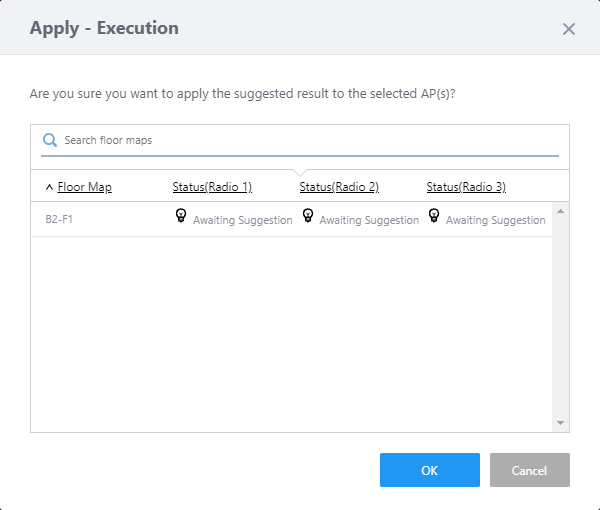
| Item Name | Description |
|---|---|
| Search Floor Maps / Search APs | You can enter part of the name to narrow down the floor maps or APs to be listed. |
| Floor Map/Device Name | The name of the floor map selected in the floor map list of the Wireless Concierge screen or the name of the wireless AP selected in the AP list of the floor map detail view of the Wireless Concierge screen will be displayed. |
| Status (Radio 1 / Radio 2 / Radio 3) |
Displays the suggestions status for the floor map or wireless APs.
|
| "OK" button |
Executes the application of suggestion. The "Apply - Execution" dialog box will close and the "Applying configuration to wireless AP(s). " screen will display. When the application is complete, click "Close" to return to the Wireless Concierge screen. |
| "Cancel" button |
Aborts the application of suggestion and closes the dialog box. If there are any suggestions in Awaiting Application status at this point, they will be currently put on hold. |
21 Oct 2022 11:56