System Setting
The System Setting page lets you see the AWC Plug-in version, factory-reset the plug-in, and configure system settings.
NoteThis page is only accessible by Administrator accounts.
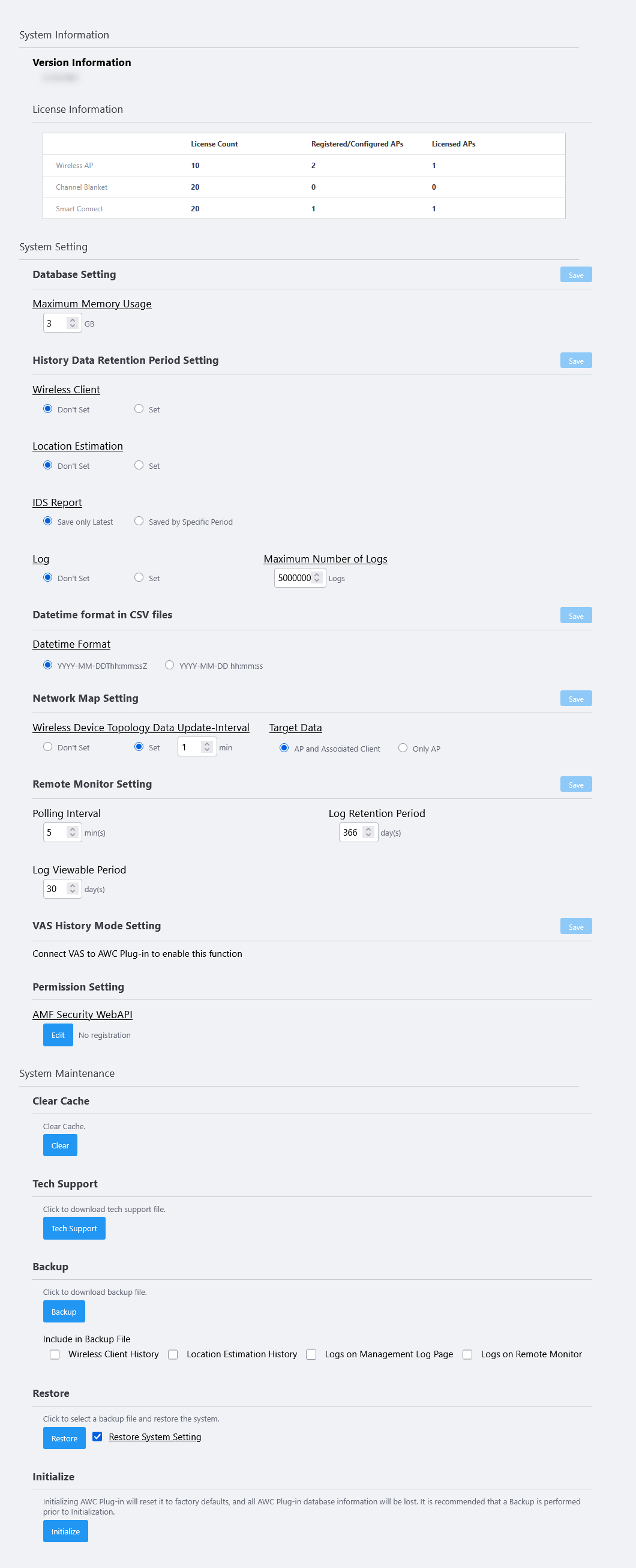
System Info
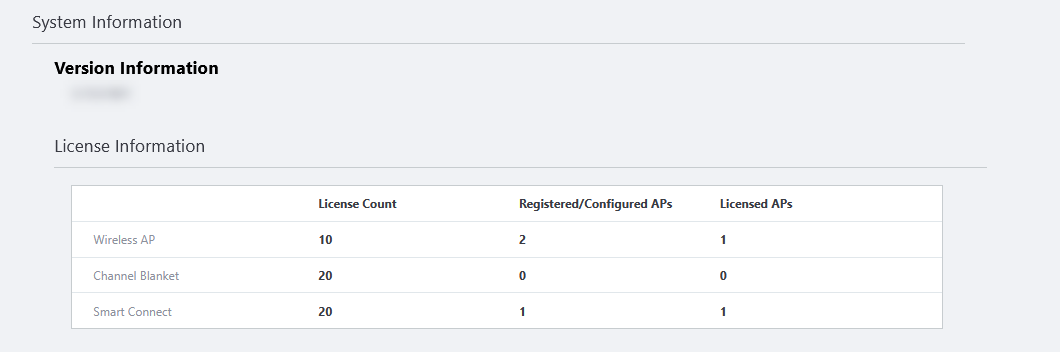
| Item Name | Description |
|---|---|
| Version Information | Shows the AWC Plug-in's version information. |
| License Information |
NoteWhen updating licenses related to AWC Plug-ins, the number of manageable units for both the pre- and post-renewal licenses may be posted in duplicate. After the grace period of the license before renewal is over, it will be displayed correctly. |
System Settings
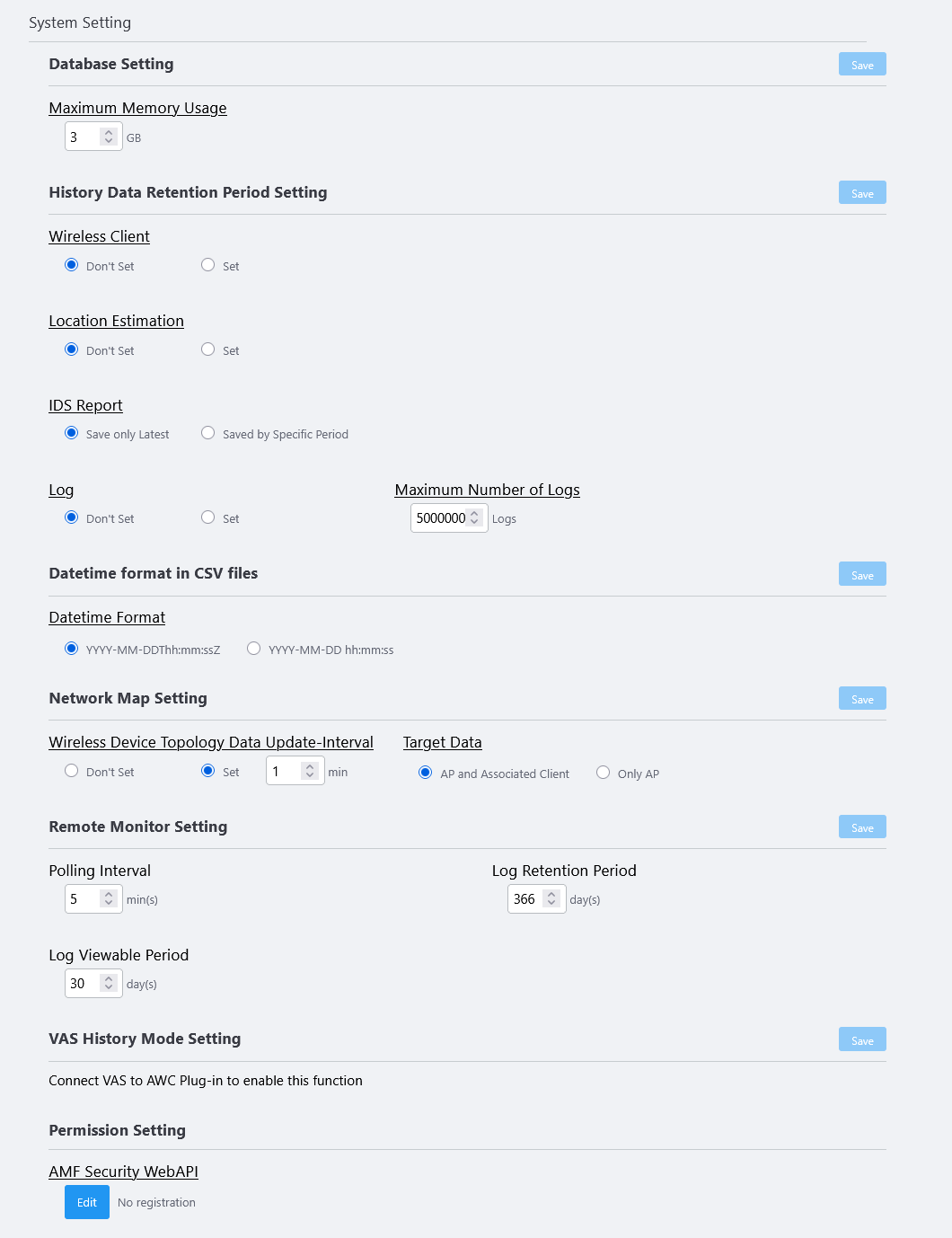
| Item Name | Description |
|---|---|
| Database Setting | |
| "Save" button | Save and apply configuration changes to the database. |
| Maximum Memory Usage | Specify the maximum amount of system memory that can be used for the AWC Plug-in database.NoteChanging the maximum memory amount is not supported in the AWC Plug-in for VST-VRT. Use the default setting. |
| History Data Retention Period Setting | |
| "Save" button | Save and apply configuration changes to the History Data Retention Period Setting in the operation. |
| Wireless Clients | Specify a retention period for associated client histories that are displayed on the Wireless Monitoring > Floor Map screen.
NoteAll wireless client history information is retained after this setting is changed. NoteThe History Data Retention Period Setting of Wireless Clients can be set up to 90 days on the screen, but we support operation up to 14 days. NoteWhen you use Wireless Client History with the following wireless APs, please set the log severity of the wireless AP to "information(6)" or "debug(7)". If the log severity is set to higher (lesser value) than "notice(5)", this feature will not work. |
| Maximum Number of Wireless Client Records | Specify the max retention number of wireles client Association / Disassociation / Failure logs with a value in the range from 1,000,000 to 100,000,000. The default is 10,000,000. |
| Client Location Estimation | Specify a retention period for location estimation histories of wireless clients and APs that are displayed on the Wireless Monitoring > Floor Map screen.
NoteWhen this item is changed from "Don't set" to "Set", or vice versa, the Config Statuses of APs belonging to a Channel Blanket will become "Modified". Please apply the configuration to the AP from either the Wireless Monitoring > Floor Map Details [Wireless Status View], Wireless Configuration > CB Profile", or Wireless Configuration > AP Settings screen after changing the setting. NoteWhen you change this setting, the Location Estimation History information will be initialized. NoteThe History Data Retention Period Setting can be set up to 31 days on the screen, but we support operation up to 14 days. NoteLocation Estimation is available on this version of the AWC Plug-in combined with TQ6602 GEN2/TQ6702 GEN2 firmware version 8.0.3-0.x or later, or TQ5403/TQ5403e firmware version 6.0.1-1.x or later. NoteWhen this feature is enabled, the maximum number of wireless APs that can have CB Profiles applied is 500 over the entire system. |
| IDS Report | Set the duration of the history to be displayed on the Wireless Monitor > IDS/IPS Report screen.
NoteWhen you change this setting, the IDS report information is initialized. NoteThe History Data Retention Period Setting can be set up to 31 days on the screen, but we support operation up to 14 days. |
| Log | Can specify how long the AWC Plug-in logs are stored in the database.
|
| Maximum Number of Logs | Specifies the maximum number of Logs related to AWC Plug-in, from 10,000 to 5,000,000. If the number of logs recorded in the AWC plug-in database exceeds the value set in this item, the oldest logs are deleted first to keep the number within the value. The default is 5,000,000. |
| Datetime format in CSV files | |
| "Save" button | Applies the change to the Datetime format in CSV files. |
| Datetime Format | Select the date/time format to be recorded in the CSV file.
|
| Timezone | Describe the timezone as a region name and a city name (e.g. "(UTC+09:00) Asia/Tokyo"). The default is "Not Set". You can also narrow down the options displayed in the drop-down list by entering a part of the timezone character string in the search field above the drop-down list. Displayed only when the "YYYY-MM-DD hh:mm:ss" format is specified for "Datetime Format". |
| Network Map Setting | |
| "Save" button | Save and apply configuration changes to the network map. |
| Wireless Device Topology Data Update-Interval | Specify the refresh interval for APs and wireless clients that are displayed on the Vista Manager EX "Network Map" screen.
|
| Target Data | Select the target data for the information displayed on the "Network Map" screen of the Vista Manager EX from "AP and Associated Client" or "Only AP". The default is "AP and Associated Client".
|
| Remote Monitor Setting | |
| "Save" button | Save and apply configuration changes to the Remote Monitor in the operation. |
| Polling Interval | Set the polling interval of the wireless LAN controller specified on the Remote Monitor screen, with a value from 5 to 30 (minutes). The default is 5 (minutes). |
| Log Retention Period | Set the number of days to keep the logs retrieved from the wireless LAN controller specified on the Remote Monitor screen, using a value from 1 to 366. The default is 366 (days). |
| Log Viewable Period | Set the number of log days to be displayed on the Remote Monitor screen, using a value between 1 and 90 (days). The default is 30 (days). |
| VAS History Mode Setting | |
NoteAT-VST-VRT does not support VAS History Mode Setting. |
|
| Permission Setting | |
| AMF Security WebAPI | Displays the sending IP address of the Web API used by our AMF-Security Controller AT-SecureEnterpriseSDN Controller (AT-SESC) and AMF Security mini. If multiple IP addresses are registered, they will be displayed separated by a slash (/).
|
Permission Setting (AMF Security WebAPI)
When the AMF Security server (AMF-Sec or AMF Security mini) receives a threat event, it queries the AWC plug-in for the MAC address from the IP address of the threat device via Web API.Register the IP address of the AMF Security server that you want to allow access to in order to respond only to inquiries from legitimate AMF Security servers.
AMF Security Server IP addresses can be registered up to 1,024 entries.
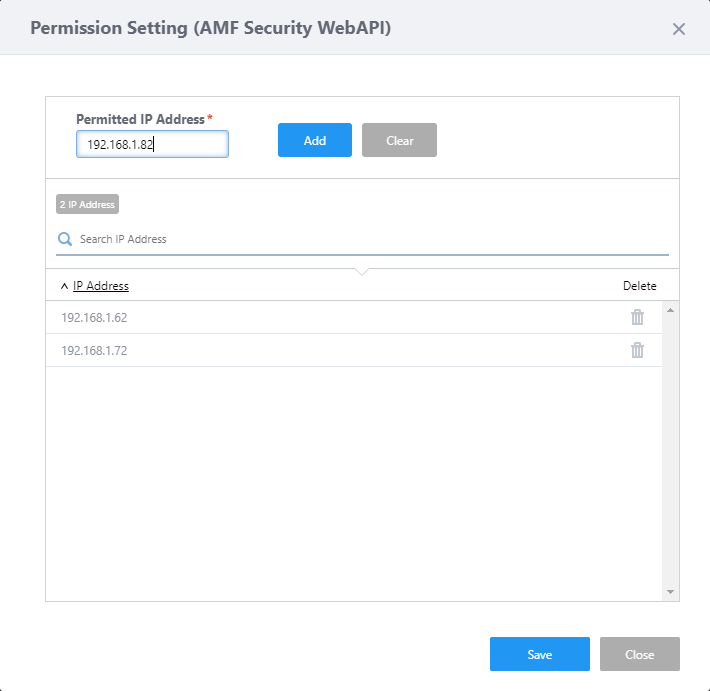
| Header | |
| Permitted IP Address | Enter the IP address of the AMF Security server to grant access to. |
| "Add" button | Add the IP address to the list. |
| "Clear" button | Clear the Permitted IP address field. |
| IP Address list | |
| X IP Address | Shows the number of IP address entries registered to the list. |
| Search IP address | Search for a particular IP address. Enter a partial string to match. The list shows entries with that string in the "IP Address" field. To remove the filter, delete the string from the search field and press enter. |
| IP Address | Displays registered IP address of the AMF Security server (AMF-Sec or AMF Security mini). |
| Delete (trashbin icon) | Deletes the entry of AMF Security server IP Address. |
| Footer | |
| "Save" button | Save changes of the permission setting and close the dialog box. |
| "Exit" button | Discard changes of the permission setting and close the dialog box. |
System Maintenance
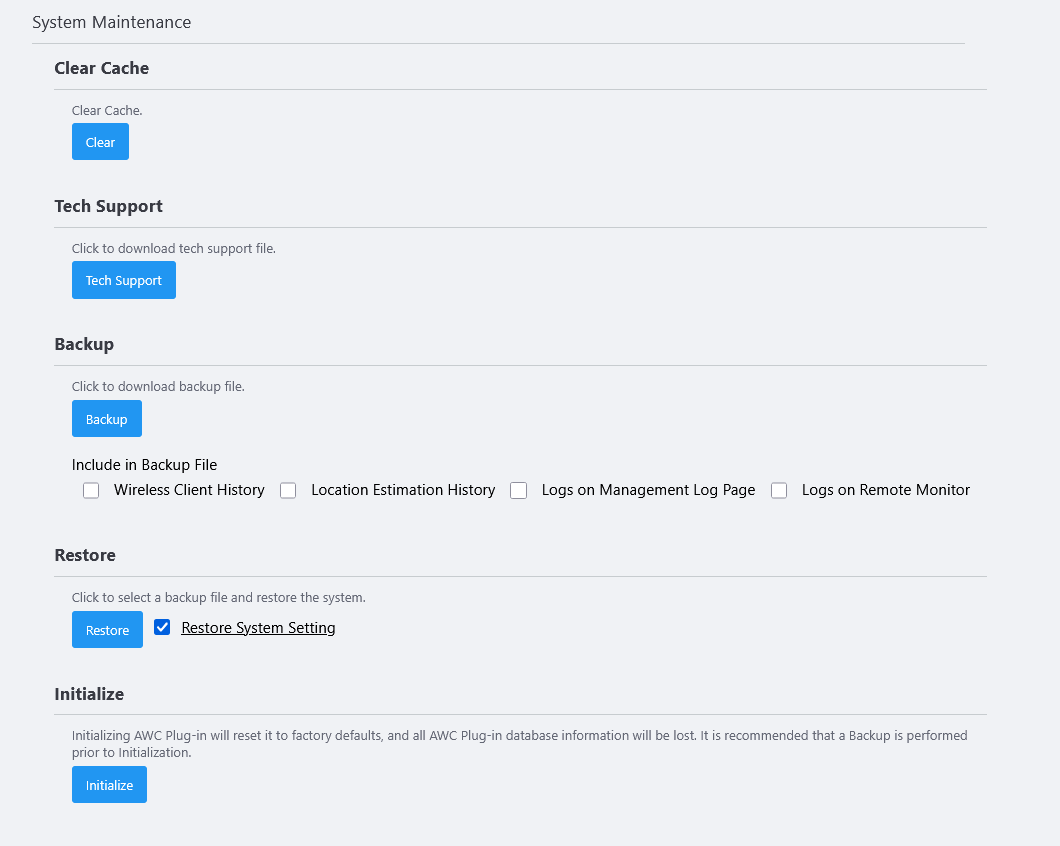
| Item Name | Description |
|---|---|
| Clear Cache | |
| "Delete" button | Clears the AWC Plug-in cache. |
| Tech Support | |
| "Tech Support" button | NoteThis button is for maintenance purposes. For use by support staff only. |
| Backup | |
| "Backup" button | Saves the current settings to an external file as a backup file. |
| Include in Backup File | |
| Wireless Client History | If checked, the backup file will include the wireless client history. By default, this option is not checked. |
| Location Estimation History | If checked, the backup file will include the location estimation history. By default, this option is not checked. |
| Logs on Management Log Page | If checked, the backup file will include the log data in the Log Management screen. By default, this option is not checked. |
| Logs on Remote Monitor | If checked, the backup file will include the log data from Remote Monitor. By default, this option is not checked. |
| Restore | |
| "Restore" button | Restores the settings from a backup file saved as an external file. |
| Restore System Setting | If checked, system settings are restored from a backup file, together with management information such as APs and floor maps. By default, this option is not checked. System Configuration includes the following:
|
| Initialize | |
| "Initialize" button | Initialize the AWC Plug-in's data, such as its configuration and various histories. |
10 Nov 2025 11:49